The Waters That Are Never Still
Christy Counts came to wine in her forties, by way of twenty-five years in animal welfare and a California she walked away from after the vineyards started burning. Now she grows grapes in the Finger Lakes and runs a tasting room in Hudson. The detour, it turns out, was the point.
She was nineteen when she decided she wanted to make wine. She was forty-nine before the rest of her life let her.
It started at a dinner in Oklahoma City in 1994. Christy Counts was home from the University of Oklahoma for the weekend, sitting at her parents’ table, and the guest of honor that evening was John Williams of Frog’s Leap. Between courses, Williams told the story of how Frog’s Leap had come to be. The grapes. The choices. The arguments. The hands that made it.
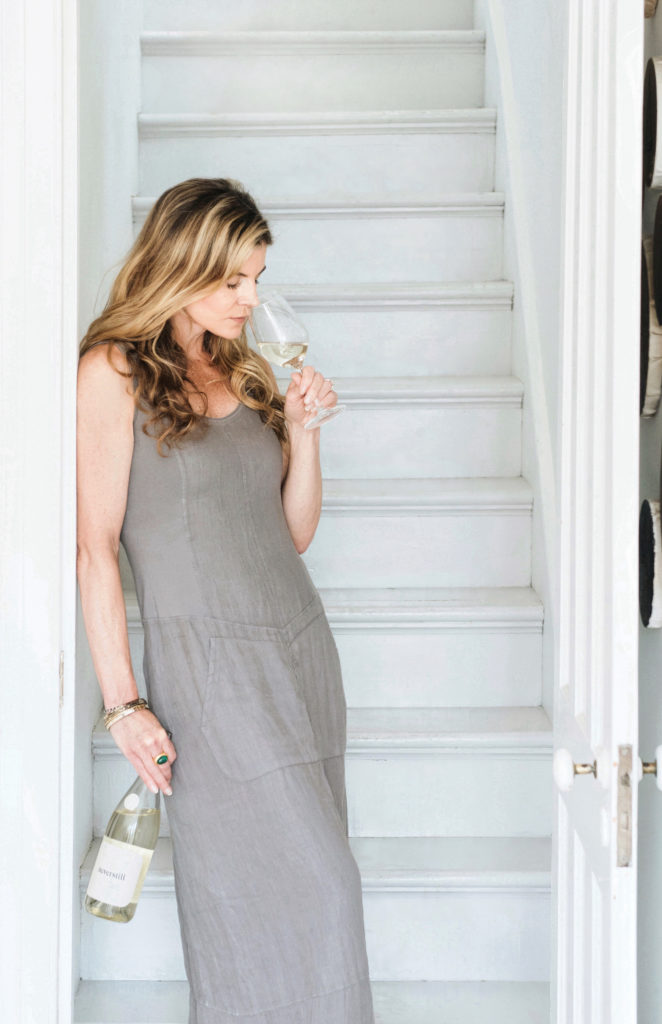
Christy had heard wine talked about before. She had not, until that night, heard wine talked about as something crafted by a person with a name and a face, who was now sitting at the table explaining his choices. The wine in her glass had a history. Someone had selected the vineyard, the type of barrel, decided when to harvest. By the time the bottle reached the table in Oklahoma City, every sip was the end of a long conversation she was only now being let into.
The room is what she remembers more than the wine. The presence required of everyone in it. How sensory the whole thing was, how tactile. Years later, talking about it, she would put it this way. She fell in love with being in a room of people all discussing this one piece of art.
She drove back to school that weekend, and the dinner kept coming back to her. Through the next week, the next month, the next year. She did not know yet that it would still be returning to her thirty years later.
Other work had a prior claim, and she answered it first.
❧
The work started early. Before college and before The Right Horse Initiative, before any of it, there was a girl in Oklahoma City who used to ask her babysitter to drive her to the local dog pound. Not her parents. The babysitter. She would write notes about the animals she met there and draw stories about them, and she told herself she was going to come back one day and fix it. She was eight or nine. She meant it.
She came back. The version of Christy Counts who walked into the Frog’s Leap dinner at nineteen was already the version who would spend the next two decades in Oklahoma animal welfare. After that came The Right Horse Initiative, a national effort to reform the way America treats horses no longer wanted by their owners, which was later acquired by the ASPCA. The arc reads, on paper, like a series of jobs. It was not. It was the answering of a promise made in childhood by a girl who took her own promises seriously.
She does not pretend the work was easy. Heartbreaking and fun, she says, in the same breath. She does not separate the two.
The handoff to the ASPCA was not an accident. Years before it happened, Christy was at a conference in her capacity at the Oklahoma Humane Society. Matt Bershadker had just been named CEO of the ASPCA. The two had never met. Christy walked up to him, introduced herself, and told him his organization needed a much better horse initiative. He asked who she was. She told him what he needed to do. Then she spent the next several years staying in his orbit, building the relationship, and eventually developing the strategic plan at the ASPCA’s own headquarters in New York.
This is the temperament. She sees what needs doing before anyone else does. She finds the right hands for the work. She waits, but she does not let go. The years between the Frog’s Leap dinner and the founding of Neverstill were not years of forgetting. They were years of attending to the prior claim, on the timeline the prior claim required.
The animals came first because they needed to.
❧
The advocate temperament had a mother behind it. Christy’s mother came from Stilwell, a small town in Adair County, and made a decision somewhere along the way that her kids were going to eat what the world ate. Cow’s tongue. Rabbit. Whatever the local butcher was willing to wrap for her. The point was less about the food than the principle behind it. People who eat narrowly tend to think narrowly, and the woman from Adair County was not raising narrow-thinking children.
Years later, after Christy mentioned all of this in a published interview, her mother called to register a complaint. “You make me sound like I’m such a hillbilly.”
She isn’t, and what that upbringing produced was a child who walked into rooms expecting to be engaged in whatever was there. Including, by her teens, wine. Christy’s parents kept a table that put her around people like Dan Duckhorn. Her father was an Oklahoma City wine collector. Her grandfather kept box wine in the fridge for months, the standing family joke. She had no way of knowing how much those evenings would matter later. By her late teens she had a good fake ID and a regular seat at Flip’s Wine Bar in Oklahoma City. The Franzia in her dorm fridge was for the buzz. Flip’s was the start of something she hadn’t figured out yet.
The Frog’s Leap dinner gave that something its name. The thirty years that followed gave it time to mature into a plan. By the time the animals were settled with the ASPCA and Christy was finally free to act on the promise she had made to herself at nineteen, she knew exactly what she wanted to do.
She was going to California.
❧
She was going to California for the same reason most American winery founders go to California. The climate is reliable. The infrastructure is built. The story is already written. She started spending real time on the ground, looking at vineyard sites, talking to growers, working with wineries she liked.
The phone calls kept changing the conversation. A realtor calling about a vineyard on fire. A grower calling about smoke taint. Another. Another. By 2026, smoke taint is no longer an anomaly. It is an embedded part of the California risk model.
Christy is not a person who walks away from a calling because of inconvenience. She walked away from California because she realized she could not fix what was happening there. She would say it later: “I need to advocate for something as a human. And it was very hard to advocate for what was happening in California.”
The pivot was not just practical. It was temperamental. She had spent twenty-five years advocating for animals who could not advocate for themselves. The wine career had to be a continuation, not a departure. California did not need her. It had its own advocates. New York was different.
Where in New York was the next question. Not the Finger Lakes, where her grapes would grow. Not the Hamptons. Not Brooklyn. She chose Hudson.
❧
739 Warren Street sits in the middle of Hudson, on the city’s main retail strip. It is Neverstill’s tasting room, and Christy hired Amy Ilias to design it. Ilias served as Executive Vice President of Art and Design at abc carpet & home in New York. Her instincts run toward warmth and texture rather than toward the polished-concrete-and-bare-bulb aesthetic that has overtaken most tasting rooms in the past decade. The room she made for Neverstill looks less like a tasting room and more like a beautiful living room someone happens to be pouring wine in.
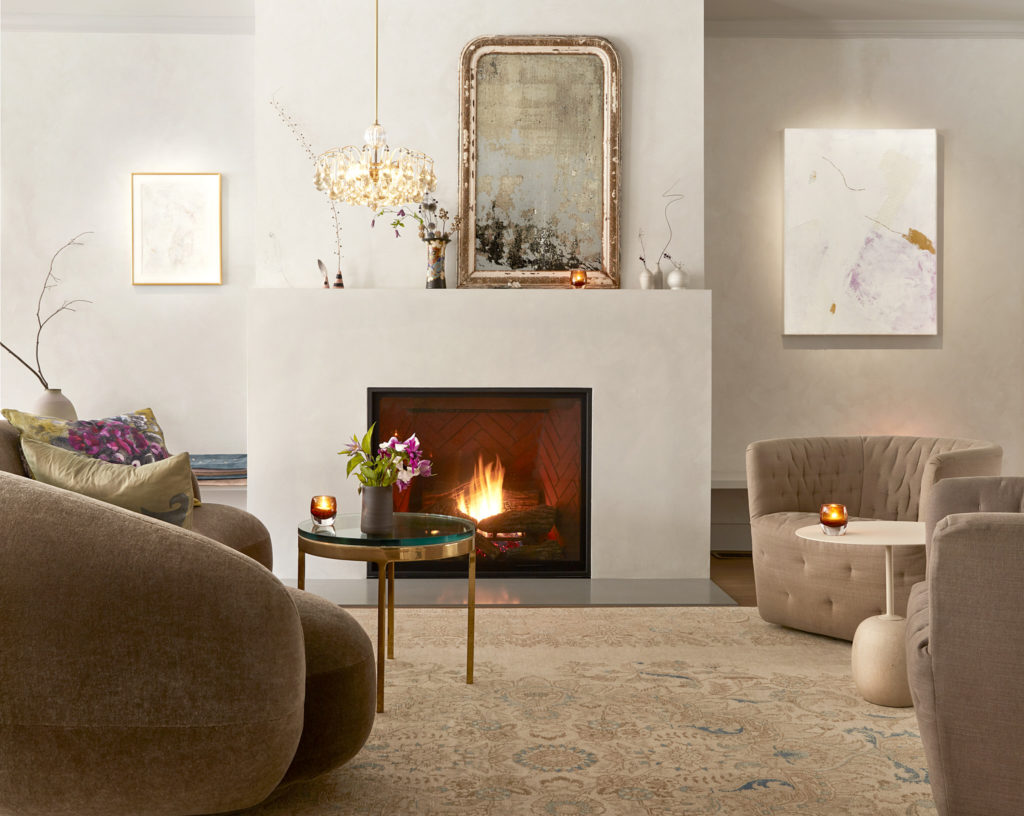
Photograph by Theo Coulombe.
That was the whole point. Christy did not want a conventional tasting room. She wanted something similar to what her parents had.
There was a bar at the front of her parents’ house in Oklahoma City. Round, marble-topped, sunken on the inside so the seats sat low and the people in them sat lower still. Big stools on the outer rim. At five o’clock, the neighbors started showing up. They didn’t call first. They didn’t need to. The rule of the house was that if you were there at five, you had a glass in front of you by ten after.
When Christy started planning the Hudson tasting room, she told the architects she wanted a sunken bar at the entrance. The architects told her no. A bar at the front of a public commercial space breaks every rule of how foot traffic and zoning and circulation are supposed to work. She lost the bar. She did not lose the feeling. The room you walk into at 739 Warren Street is not the Oklahoma City foyer, but it is the same idea translated into another form.
The room has one address. The brand has three. Neverstill grows its grapes in the Finger Lakes, at a vineyard called Hidden View on the left bank of Seneca Lake. The tasting room is in Hudson. Christy herself lives in Westchester, between the two. Three New York regions carry part of Neverstill. None carries all of it. The brand named for constant motion is, in a literal sense, made out of motion.
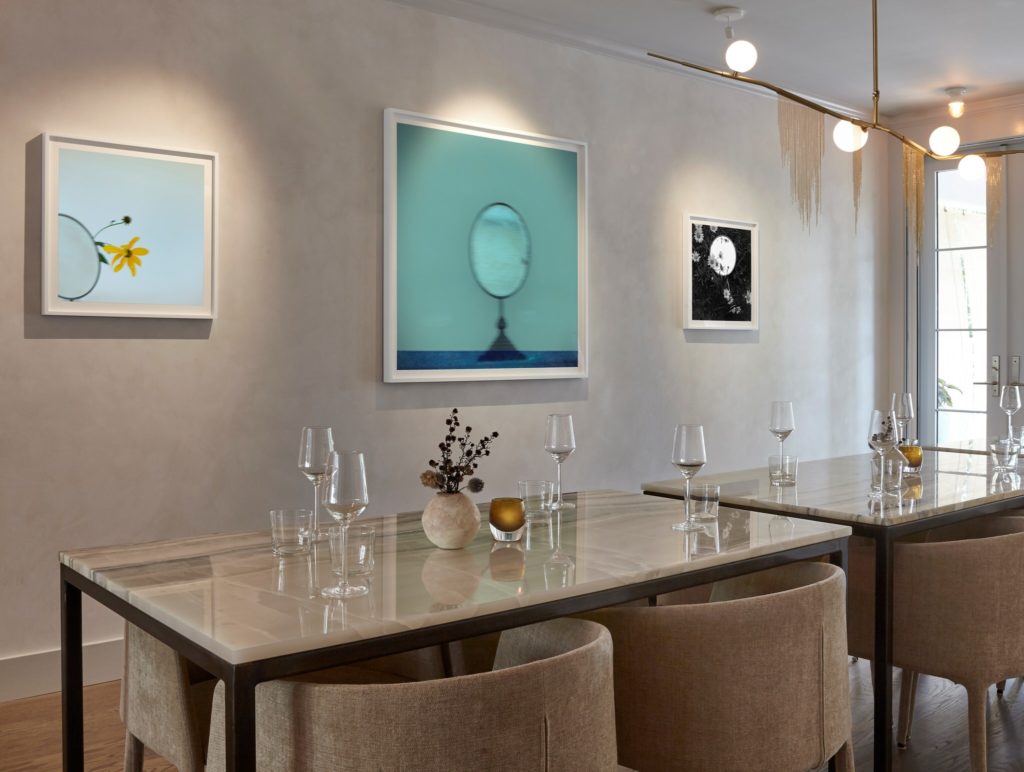
Installation photograph by Standard Space.
The name itself is the deepest connection to the land, and the most exposed one. Neverstill is a direct translation of the Mohican name for themselves. Their original name, Muhheaconneok, means the people of the waters that are never still. The Mohican land included the Hudson River Valley where the tasting room now sits. The contemporary Stockbridge-Munsee Band of Mohican Indians was pushed off that land in the early nineteenth century and is now headquartered in Wisconsin.
Christy is honest about what is and is not in place between Neverstill and the Stockbridge-Munsee. There is a land acknowledgment on the tasting room wall. There is not yet dialogue with the contemporary community whose name the brand has borrowed. The gesture is on the wall. The conversation is not yet at the table.
❧
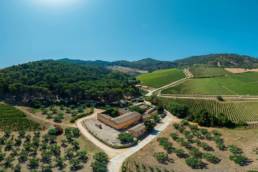
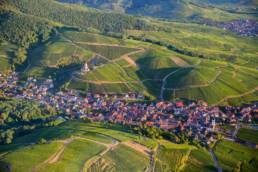
The vineyard is called Hidden View. Nine acres on the left bank of Seneca Lake, where the deepest of the Finger Lakes pulls warm air off its surface in the fall and protects the vines from the worst of the frost. It is good ground for cool-climate grapes.
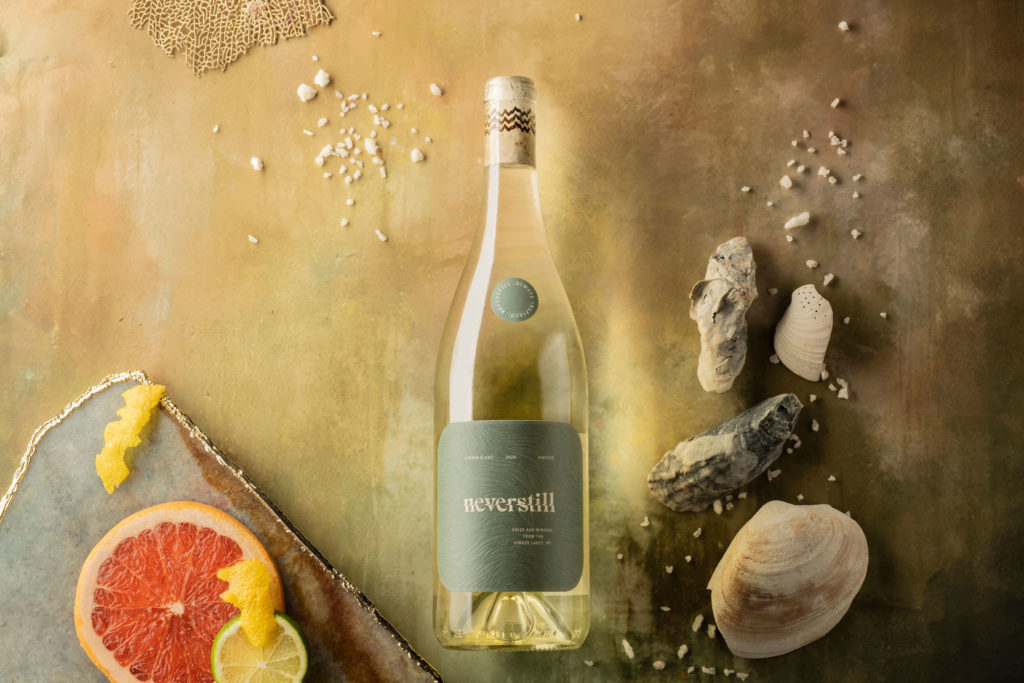
The Chenin Blanc is the first wine that announces what Neverstill is doing. Chenin Blanc is not the obvious choice in the Finger Lakes. Few producers grow it. The Neverstill version has the racy, almost crescendoing acidity the variety wants and the lake-fed minerality the region gives it, and it carries both without straining for either. It begs for food. It also begs to be drunk after exertion, the way Christy describes it, on a porch after a tennis match in the heat.
Christy is replanting Chenin vines this season after losing more of them than expected to last year’s drought. The 2024 will sell through quickly. There will be no 2025. She is hoping for a 2026.
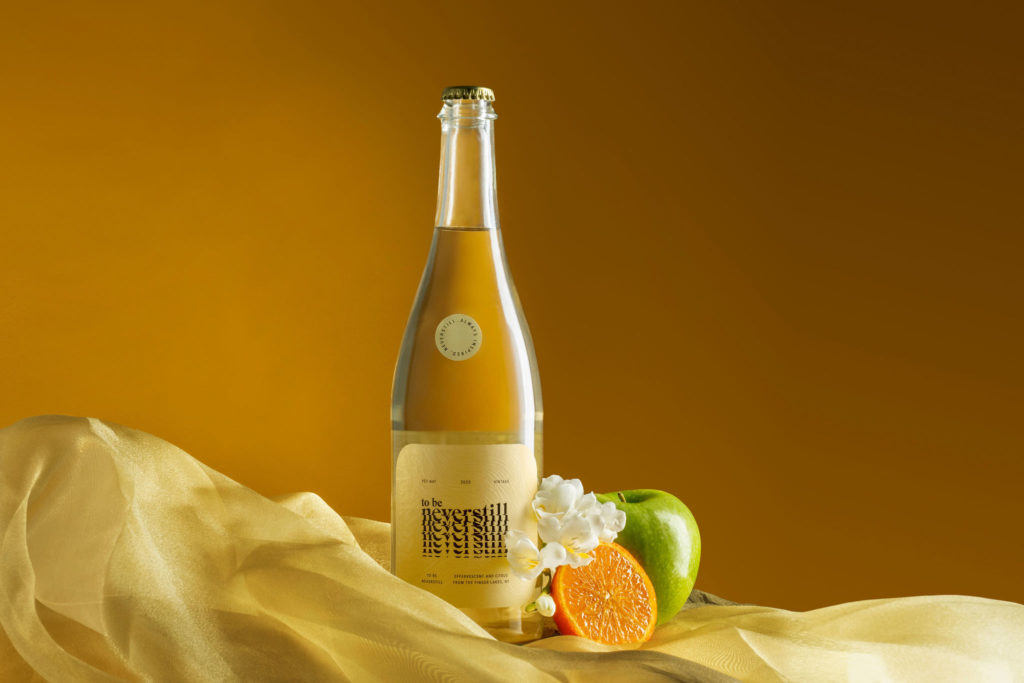
Then the Petnat. Pétillant naturel, the rustic ancestor of modern sparkling, finishes its fermentation in the bottle and is capped without disgorgement. The 2024 Neverstill Petnat is 9.5 percent alcohol, which is low even by Petnat standards, and the wine is bright and clean in a way that surprises drinkers who associate the category with funk and ferment-noise. Christy poured it at a wine dinner the night before we spoke. A guest at the dinner waved off the sparkling course. He was not a sparkling person. Christy walked back over after the host had moved on. “I really think you should try this,” she said. He was taken aback. “Listen. This is kind of like champagne’s sexy little sister. I know you don’t think you like sparkling wine. Do you like beer?” He said he did. She told him to try it. By the end of the night, he was buying a bottle.
That is the temperament caught in the act. She advocates for the wine the guest didn’t think he wanted, the way she advocates for the New York wine region the sommelier didn’t think to put on the list, the way she advocated for the shelter dogs nobody was looking at. Same instinct, smaller stage.
Nova Cadamatre, the first female winemaker in the United States to earn the Master of Wine title, oversaw the first two vintages. Christy admits that she stalked her a little bit. The stalking took the form of renting an Airbnb that Nova owned in the Finger Lakes, which is one way to get a winemaker’s attention.
Christy has no co-founder. She runs the brand alone, seven days a week, splitting her time between Hudson, the Finger Lakes, and her family’s life in Westchester. When asked about this, she will tell you, with the half-laugh of someone who is genuinely amused by her own situation, that she now understands why most women winery owners have partners. The line is funny because it is true. It is also, on a longer reading, the kind of thing a person says when they have decided to do something difficult on purpose.
❧
Christy is not done finding things to advocate for, and her latest cause is the one most of the wine industry in 2026 would rather not name. The mood is defensive. The surgeon general’s advisory. The neo-prohibition essays. The cultural drift toward zero-proof. Producers are quiet, hoping the conversation moves on.
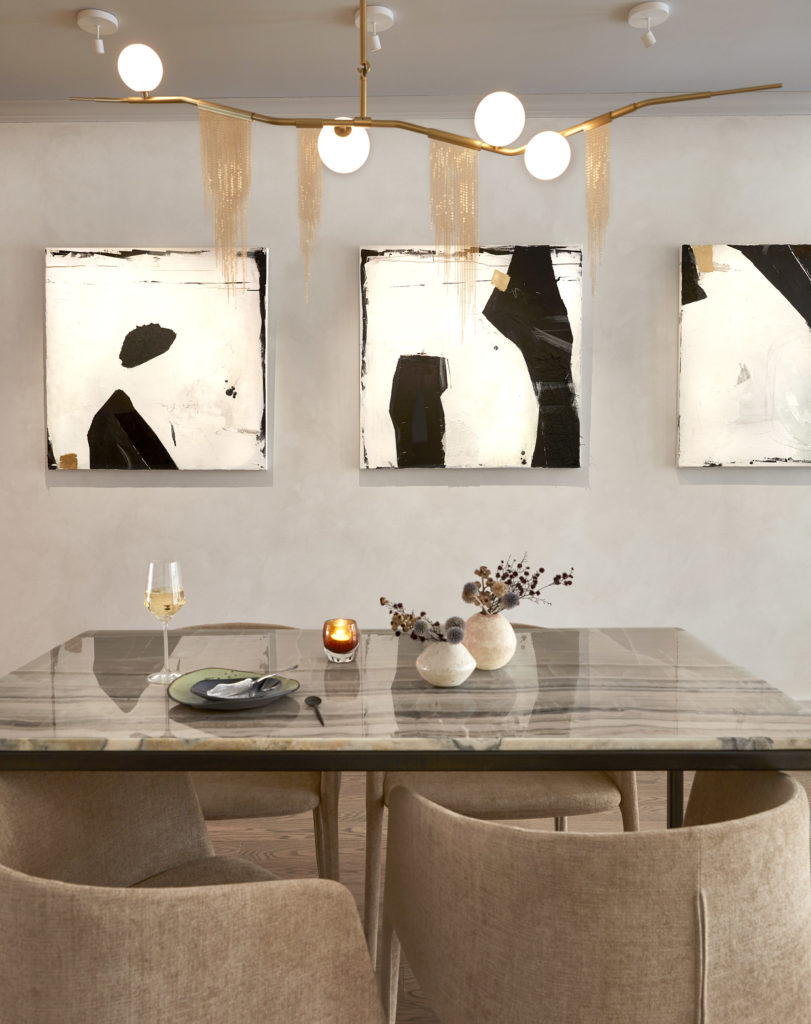
Photograph by Theo Coulombe.
Christy is not quiet. She wants Neverstill to be part of the wellness conversation, not in retreat from it. Her position is direct. Wine is a vehicle for presence and community and shared attention. The value of those things, in a world starving for them, outweighs the harm of moderate consumption. She is not arguing that wine is medicine. She is arguing that the wellness conversation has, for the moment, conceded a piece of ground it did not need to concede.
There is one more thing the brand name carries that the marketing materials do not say. Christy has, in her own words, a horrible fear of growing older. She fights it by being constantly in motion, attending to things, building things, refusing to stop. The Mohican meaning of Neverstill is the official explanation. The personal meaning sits underneath it. Both are true. The woman who waited thirty years to make wine is not a woman who has any patience left for stillness.
❧
Christy’s parents came up to see her in Hudson not long ago. She walked them down Warren Street to a restaurant called Cafe Mutton, a few doors from the tasting room. The menu at Cafe Mutton runs heavy on the cuts most American restaurants leave off the page. Her father looked at the menu for a while and ordered the pig’s head sandwich. He liked it.
Forty years and change after a woman from Adair County had decided her kids were going to eat what the world ate, her husband was sitting down to a pig’s head sandwich in upstate New York. The principle had traveled well.
Neverstill is launching distribution in Oklahoma, with events in Tulsa and Oklahoma City. Most distributor launches are not the kind of thing a wine piece would mention. This one is different. The distributor is a business run by animal advocates. The office, by Christy’s account, is full of rescues. Under the terms of the deal, a dollar from every bottle of Neverstill sold through the distributor goes back to animal welfare organizations in Oklahoma City.
This is where Christy started. Oklahoma Humane Society. The Right Horse Initiative. The shelter she used to ask her babysitter to drive her to, where she wrote her notes and drew her stories. The girl who at eight or nine had told herself she was coming back is now, more than four decades later, sending money back from a vineyard in the Finger Lakes through a tasting room in Hudson through a distributor in Oklahoma to the animals in the city she started from.
She never let go of the wine. She never let go of the animals either. The Neverstill in her, the part that refuses to stay still, is the part that has been finding ways to keep both promises at once.
About Neverstill Wines
Neverstill Wines is based in Hudson, New York, with vineyards on Seneca Lake in the Finger Lakes. The tasting room is located at 739 Warren Street in Hudson and is open to the public. Neverstill recently released its 2024 Chardonnay and 2024 Riesling, both available through the tasting room and select distributors. As of July 2026, Neverstill wines are distributed in Oklahoma, with a dollar from every bottle sold benefiting animal welfare organizations in Oklahoma City.
Website: neverstillwines.com
Tasting Room: 739 Warren Street, Hudson, NY 12534
Instagram: @neverstillwines
Photography credits: Tasting room by Theo Coulombe. Portfolio photography by Meghan Spiro. Exhibition artwork by Jeannette Montgomery Barron; installation photography by Standard Space. Portraits of Christy Counts by Mendy Waits.