

Two Ways In: An Eight-Generation House and a French-Japanese Marriage, Both Making Wine in Alsace
Wine is made by people, and people do not work alone.
Some partnerships span generations. Father to son, century after century, the same vines in the same village, the same questions asked of the same soil. Others begin with a meeting. Two people from different worlds who decide, for reasons neither could have predicted, to build something together.
Alsace has both. Two bottles on my table this week made that plain. Two villages, two families, two ways in.
The villages sit a short drive apart in the foothills of the Vosges. Orschwihr to the south, Hunawihr to the north. Both have grown grapes for centuries. Both have families who never left.
In Orschwihr, Balthazar Albrecht settled in 1698, a few decades after the Thirty Years’ War had laid much of Alsace to waste. He worked the land, planted vines, and handed both down. His descendants are still there, eight generations later, on the same slopes he chose more than three hundred years ago. The house that carries the family name, Lucien Albrecht, went on to help invent sparkling wine as the region knows it, running its first Crémant trials in 1971 and helping secure the AOC Crémant d’Alsace in 1976. They were not after attention. They put in the work because they believed the wine deserved real recognition, and they spent decades making the case. Alsace without its crémant is hard to imagine now, and the region owes part of that to houses like this one.
The partnership at Albrecht is vertical. The line runs across time. Each generation inherits the terroir, the knowledge, and the responsibility to hand it forward intact. The winemaking follows from that inheritance: minimal interference, respect for the land, Agri Confiance certified since 2012. This is not a house that chases the moment. It shows up, does the work, and passes it on.
The vines climb the hillsides above Orschwihr, the Pfingstberg and the Bollenberg, where chalky, calcareous soil and a warm southern exposure hand Alsace Riesling its tension and its lift. Three centuries on, the family still draws every grape from these estate slopes, nothing bought in.
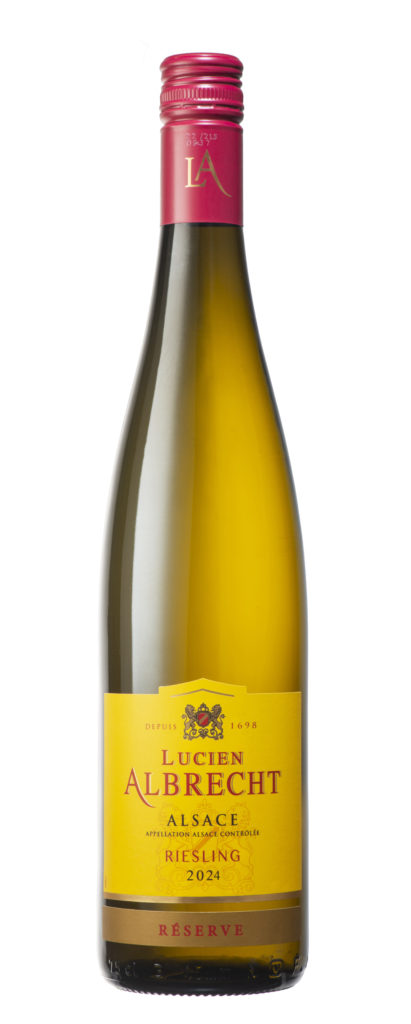 The Lucien Albrecht Riesling Réserve 2024 ($23) is form. The classic expression, the grape Alsace built its name on, made by people who have been making it for three centuries.
The nose carries ripe orchard fruit, apple and pear, with citrus and the faint whisper of petrol that marks Riesling from this place. Jasmine drifts underneath. The palate is bone dry, with bright, mouth-watering acidity and a surprisingly viscous texture that carries the wine across the tongue. The fruit turns toward citrus here, tangerine and pineapple, and the finish is long, faintly briny, and clean. This is what Riesling becomes when one family has shaped it for three hundred years.
A few villages north, in the shadow of the fortified church of Hunawihr, the Mittnacht family has farmed for generations too. In 1999 they became one of the first estates in all of Alsace to convert to biodynamic farming, back when most of the wine world still dismissed the idea as fringe. That alone would make them worth knowing.
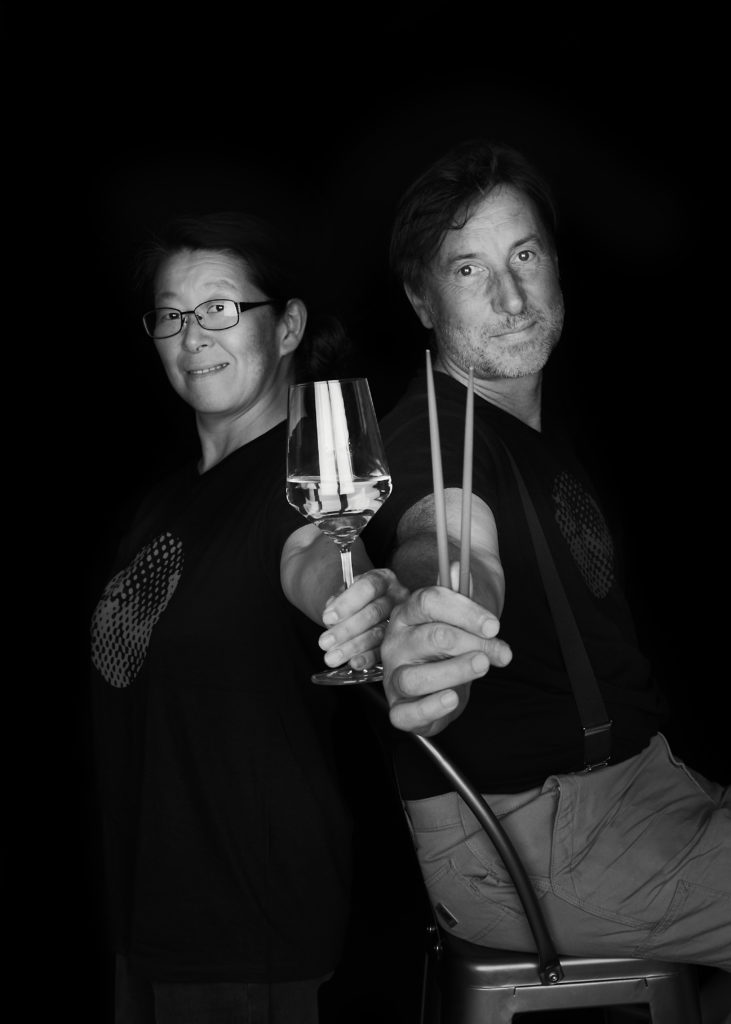 But the better story started at harvest. Yuka, a chef from Tokyo whose father runs a restaurant there, came to Alsace to pick grapes in Christophe’s vineyards. She came for a season. She stayed for a life. They married, and around 2019 the two of them broke off from the family holdings to build something of their own, a domaine and label called Terres d’Étoiles. Land of stars.
The marriage did not just change Christophe’s life. It changed his wine. Yuka cooks, and these days she runs a guesthouse in the Alsatian hills where she hosts sushi workshops. At the table they share, the cooking is hers and the wine beside the fish is his. Somewhere between her kitchen and his cellar, a question took shape that almost no Alsace winemaker had thought to ask. What would a wine built for raw fish actually taste like? What would it take to make a white that could sit beside soy and wasabi and a slice of fresh tuna without flinching?
Blend after blend, taste after taste, until they had their answer. They called it Gyotaku.
Gyotaku is the Japanese art of fish printing, gyo for fish, taku for impression, a practice that began in the eighteen-hundreds as a way for anglers to record a prized catch, inking the fish and pressing it to paper before the thing could spoil. A fish print sits on the label, and the wine beneath it was built for the table that art comes from. Not a gimmick. A purpose, arrived at by two people from two cultures who kept asking what they could make together that neither could have made alone.
The partnership here is horizontal. It runs across cultures rather than down through years. The fruit comes from thirty-year-old vines on clay and limestone around Hunawihr and Ribeauvillé, fermented with wild yeast and raised in large old foudres, the unhurried, hands-off winemaking Christophe has practiced since his biodynamic beginnings.
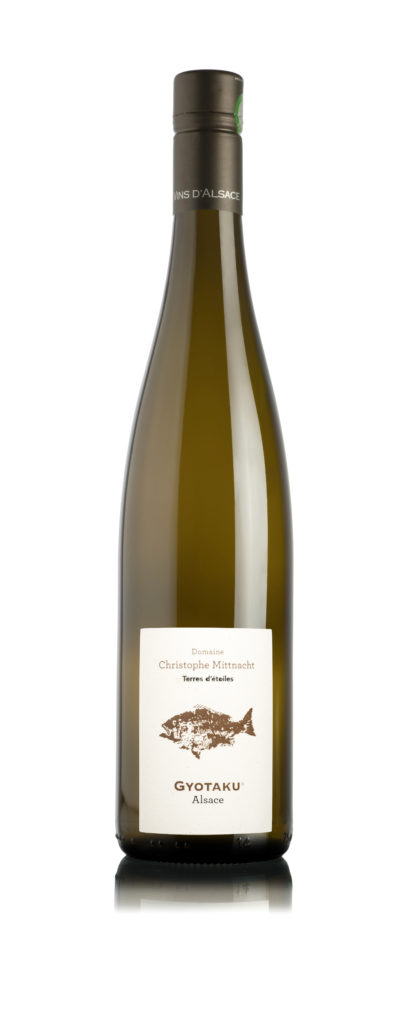 The Christophe Mittnacht Gyotaku 2024 ($25) is freedom. A biodynamic blend of five grapes: 45% Pinot Blanc, 23% Pinot Gris, 16% Gewürztraminer, 8% Riesling, and 8% Muscat. A wine that exists because two people from different worlds built something together.
The nose is perfumed and layered, orchard fruit of peach and apricot and pear, florals of honeysuckle and blossom, and then a lift of warm Asian five-spice, sitting exactly where it belongs in a wine made for that table. The palate comes in just off-dry, but the time on the fine lees and the Gewürztraminer give it a viscous, almost oily weight that reads as texture rather than sugar. Tropical citrus, tangerine and lemon curd, a thread of briny minerality, and a long, mineral finish. The perfume carries from the first sip to the last.
A wine for sushi. A wine for sashimi. Pour it beside a piece of tuna nigiri with a smear of wasabi and a dish of soy, and the faint sweetness shows its purpose, a cushion that meets the salt and the heat rather than fighting them. A wine for the conversation between two cultures that began in the rows at harvest, when a winemaker met a chef.
Two wines. Two partnerships. One spans eight generations and more than three hundred years. The other began when a French winemaker married a Japanese chef and asked what they could make together.
Both farm with respect for the land. Both believe in leaving the wine mostly alone. Both make whites that want food, reward attention, and refuse to shout.
Alsace has more than one door. These are two of them. Walk through either door and the wine will be waiting.
Bottle Talk: Lucien Albrecht Riesling Réserve 2024 (about $23) and Christophe Mittnacht Gyotaku 2024 (about $25) are both available through good retailers and online, and both ship widely across the United States.



Terrific story…actually stories! I enjoyed reading it. Made me thirty for an Alsace white.
Dave,
Thank you so much for reading it and for your kind words. The fact that it made you crave Alsatian wines, means I did my job. Thank you so much.
Thirsty, that is!